

Overview
Call transfers let your AI agent pass a live call to the right person, team, or AI agent, without hanging up. For example, the agent can send a caller who wants a quote to your sales line, or hand a technical question to a specialized agent. Two places are involved:- Call Transfer (left menu, under Telephony): your list of Call Transfer Rules, each with a name, a number, and a condition.
- The agent’s Tools tab: the Transfer to number and Transfer to agent system tools, which turn transfers on for that agent.
Saved Call Transfer Rules don’t do anything by themselves. Transfer to number uses the number and condition saved in the tool, so add them in the agent’s Tools tab (Step 2).
Step 1: Create a Transfer Configuration
In the app, transfer configurations are called Call Transfer Rules.Video: Call Transfer → Create Rule → fill in Title, Number, and Condition.
1
In the left menu, open Call Transfer (open it here). If you don’t have any rules yet, you’ll see No Call Transfer Rules found.
2
Click + Create Rule.
3
Fill in the three fields. All of them are required:
- Title: a name for this rule (for example, Sales team or Support).
- Number: the number where the call will be transferred, in E.164 format, with + and the country code (for example,
+393331234567). - Condition: when the agent should transfer the call. This lets the LLM know when to transfer the call to this number (for example, “Transfer the call when the caller asks to speak with sales, wants a price quote or is ready to buy.”).
4
Click Save.
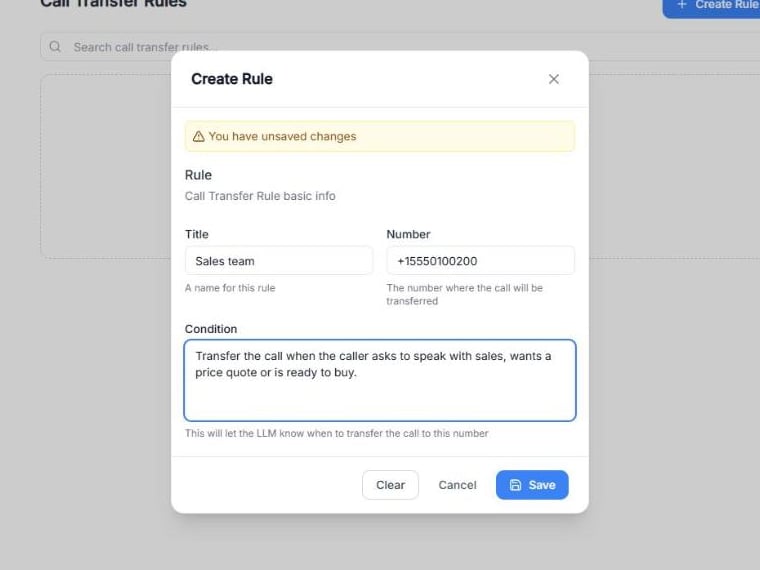
Screenshot: a rule that sends sales calls to the sales team.
Step 2: Activate Call Transfer for an AI Agent
Transfers are turned on in each agent, in the System Tools of the Tools tab.Video: Tools tab → Transfer to number → Add Rule → Destination Type → Phone Number and Condition.
1
Go to AI Agents and open the agent.
2
Open the Tools tab. On the right, under System Tools, turn on Transfer to number (“Provides a seamless connection to a live team member when a human touch is needed or requested by the caller”).
3
The Edit Transfer to Number Tool panel opens. Under Human Transfer Rules, click Add Rule and fill in:
- Destination Type: Phone Number (always the same number) or Phone Number as Dynamic Variable (a number that comes from a variable, for example one per contact or per office).
- Phone Number (or Phone Number as Dynamic Variable): where the call goes.
- Condition: when to transfer to this number.
4
Add one rule for each destination. Use Remove Rule to delete one.
5
Click Save in the panel.
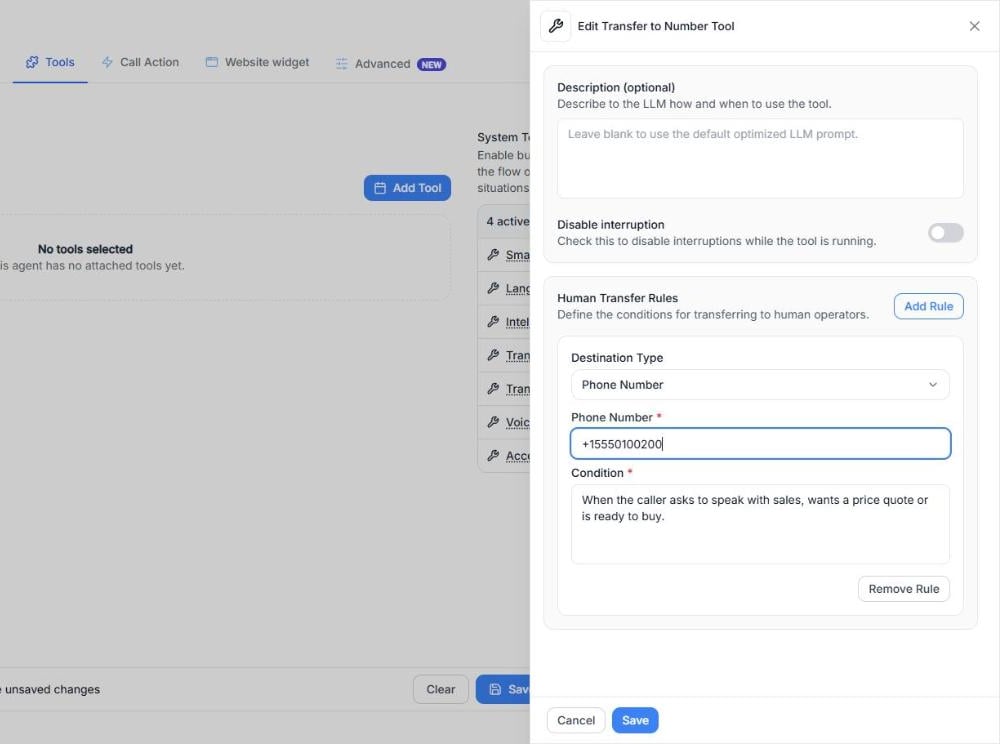
Screenshot: a Human Transfer Rule in the Transfer to number tool.
- Description (optional): tells the LLM how and when to use the tool. Leave it blank to use the default optimized prompt.
- Disable interruption: the caller can’t interrupt while the transfer is running.
Transfer to another AI agent
To pass the call to a more specialized AI agent instead of a person, turn on Transfer to agent in the same System Tools list. In Transfer Rules, click Add Rule and choose:- Agent: the agent that takes over the call.
- Condition: when to transfer to that agent.
- Delay before transfer (milliseconds): how long to wait before transferring.
- Transfer message: the exact phrase the agent says before transferring.
- Enable First Message: whether the new agent plays its greeting after the transfer.
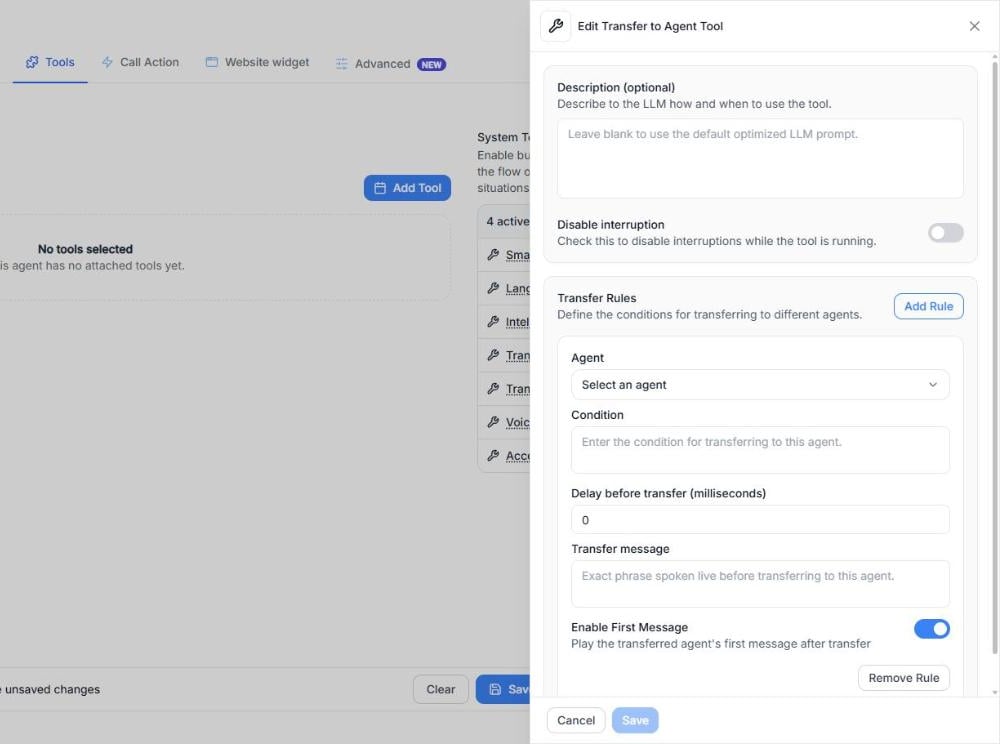
Screenshot: a Transfer Rule in the Transfer to agent tool.
Step 3: Save and Test the Setup
When you change the agent, a bar with You have unsaved changes appears at the bottom of the page. Click Save to store the changes, or Clear to discard them.Testing Your Configuration
1
In the agent, click Test AI agent to talk to it in your browser, or Test Call to receive a real call.
2
Say something that matches one of your conditions (for example, “I’d like a price quote”).
3
Check that the agent transfers the call to the right number or agent.
Who pays for a transferred call
The account that owns the agent pays. The person who receives the transfer isn’t charged. In Premium Voice agents, the call stays connected, so the account also pays for the time after the transfer. In Custom Stack agents, Callin minutes stop when the call passes to the person.Tips & Best Practices
- Create one rule per destination.
For example: Sales, Support, Billing. Each one with its own number and condition. - Write clear, specific conditions.
The LLM decides when to transfer based on the condition. “When the caller asks for a refund or a billing change” works better than “billing”. - Use clear, consistent names.
This helps you find rules quickly when you manage many agents. - Always use the international format.
Numbers must start with + and the country code (E.164). - Don’t transfer to a number that forwards to the agent.
If your main number forwards to the agent, transferring to it sends the call back to the agent, and it goes round in a loop. Use a direct line or a mobile.
Troubleshooting
Issue: I can’t save the ruleCause: A required field is empty or the number isn’t in E.164 format.
Fix: Fill in Title, Number, and Condition, and write the number with + and the country code. Issue: The agent never transfers
Cause: Transfer to number isn’t on, the agent wasn’t saved, or the condition doesn’t match what callers say.
Fix: Check the tool in the Tools tab, click Save in the agent, and make the condition clearer. Issue: Calls go to the wrong number
Cause: Two rules with overlapping conditions, or a wrong number.
Fix: Make each condition specific and check the numbers in Human Transfer Rules.