

What you’ll set up (and why it matters)
Google Calendar scheduling in Callin.io is designed to be reliable and consistent. To achieve that, the setup is split into two parts:- Google Calendar integration setup
You connect your Google account and create an Event Template. This template is where you define the booking rules (days available, appointment duration, reminders, and conflict rules). - AI Agent setup (Call Action)
You enable Schedule Appointment inside your agent and select the template you created.
Important: Your booking rules should live in the Event Template, not in the agent prompt. Avoid adding instructions like “Only Monday to Friday” or “Only between 9am and 5pm” inside the prompt—those rules can conflict with the platform’s built-in scheduling logic once Google Calendar is connected.
Open the Google Calendar integration
Use this direct link to open the Google Calendar integration page: click here.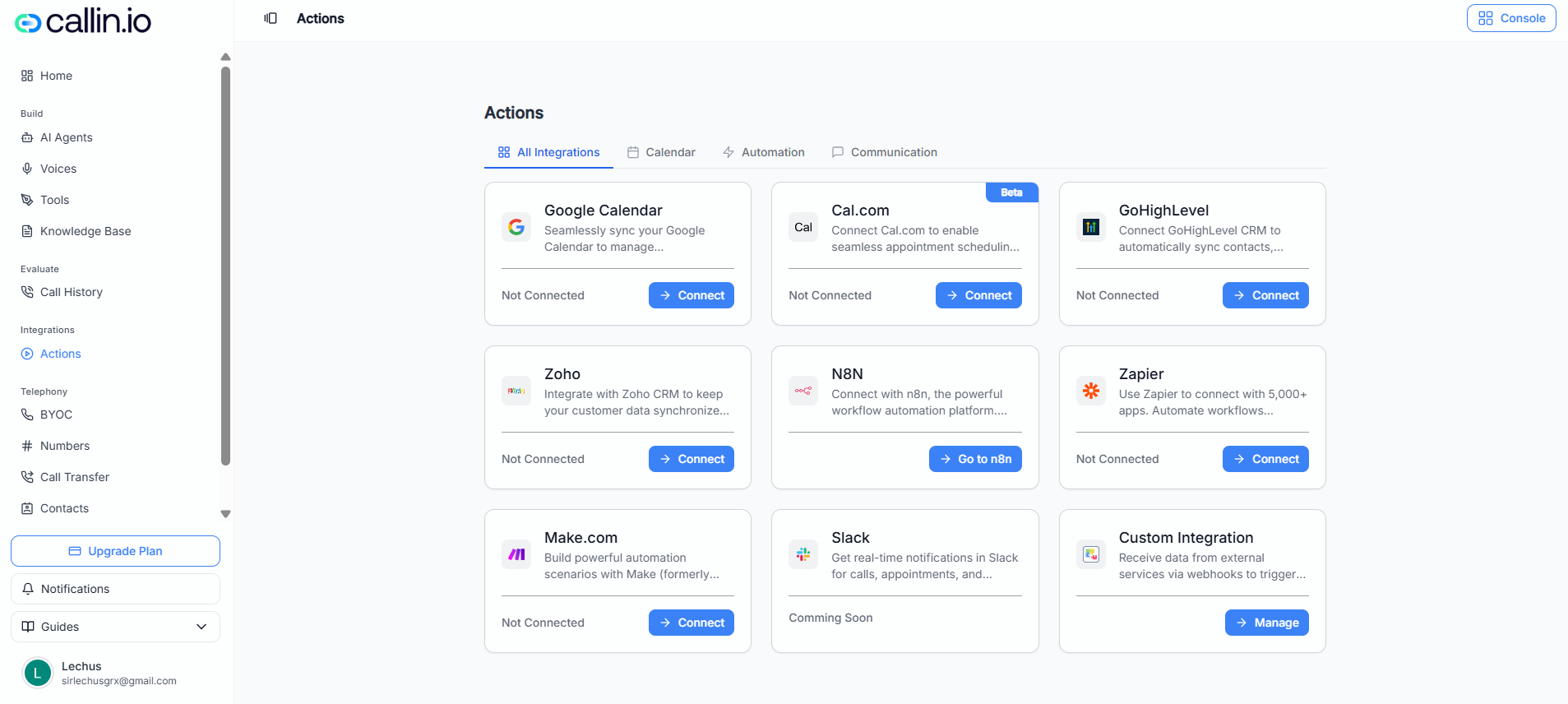
Screenshot: This is the Google Calendar integration area where you connect your account, choose a calendar, and manage event templates.
Tip: If your UI looks slightly different, that’s normal—some elements can vary by account or plan.
Step 1: Connect your Google Account
- On the Google Calendar integration page, click Connect Google Account.
- A Google sign-in window opens. Choose the Google account you want to use for bookings.
- Approve the permissions screen so Callin.io can create events and check availability.
- Your Google account displayed in the left panel
- A list of calendars you can select
- A Disconnect Account option (use it if you connected the wrong account)
Important: Use a calendar that represents your real availability. If your Google Calendar is always “busy” (or always “free”), the booking experience won’t match reality.
Step 2: Choose the calendar where appointments should be created
In the left panel, select the calendar you want bookings to go into. Examples:- A service business might use a calendar named “Appointments”
- A sales team might use “Discovery Calls”
- A clinic might use “Consultations”
- Your template is built for a specific calendar
- The agent will book into the calendar/template you assign later
Tip: If you have multiple calendars (for different teams or services), you can create different templates per calendar and assign the right one to each AI Agent.
Step 3: Create an Event Template (this is where scheduling rules live)
Before attaching scheduling to an AI Agent, you must create at least one Event Template. This template defines:- How long appointments are
- How reminders work
- Whether overlapping bookings are allowed
- How conflicts are handled
- Which days are available for bookings (Working Hours)
- In the Event Templates section, click Create Event Template.
- Fill out the fields (details below).
- Click Save.
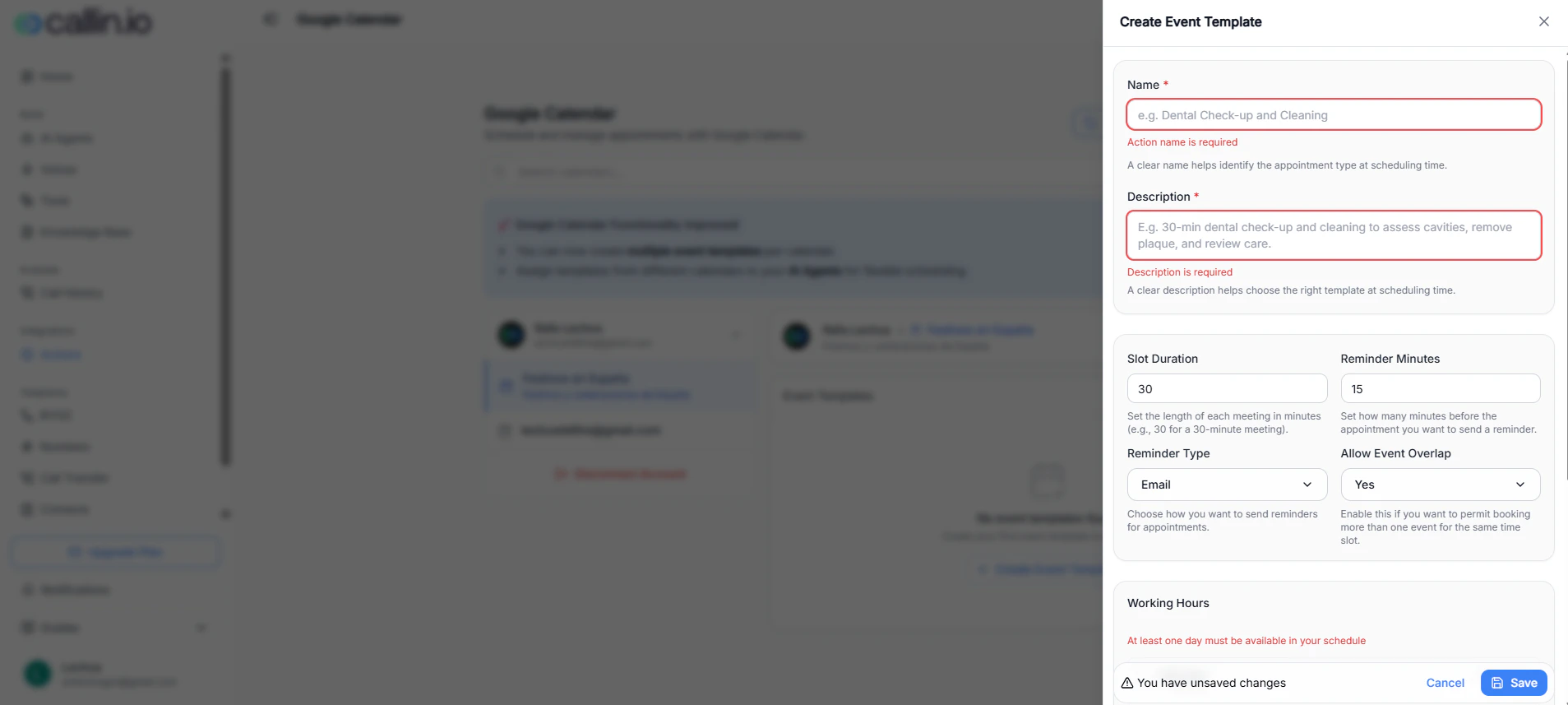
Screenshot: The Event Template editor where you define duration, reminders, conflict rules, and working days.
Field-by-field explanation (with practical examples)
Common mistake: Leaving Working Hours with no days selected. The template won’t be usable until at least one day is enabled.
A complete example template (recommended starting point)
If you want a safe default:- Name: “Discovery Call (30 min)”
- Description: “First call to understand needs and confirm next steps”
- Slot Duration: 30
- Reminder Minutes: 15
- Reminder Type: Email
- Allow Event Overlap: No
- Conflict Handling: Block overlapping events
- Working Hours: Monday–Friday
Step 4: Attach Google Calendar scheduling to an AI Agent (Call Action)
After you have:- Connected a Google account, and
- Created an Event Template,
- Go to AI Agents in the left menu.
- Open the agent you want to configure and click Edit.
- Go to the Call Action tab.
- Turn on Schedule Appointment.
- Select Google Calendar as the provider.
- Click the settings icon (gear) to open configuration and select the template you created.
- Click Save.
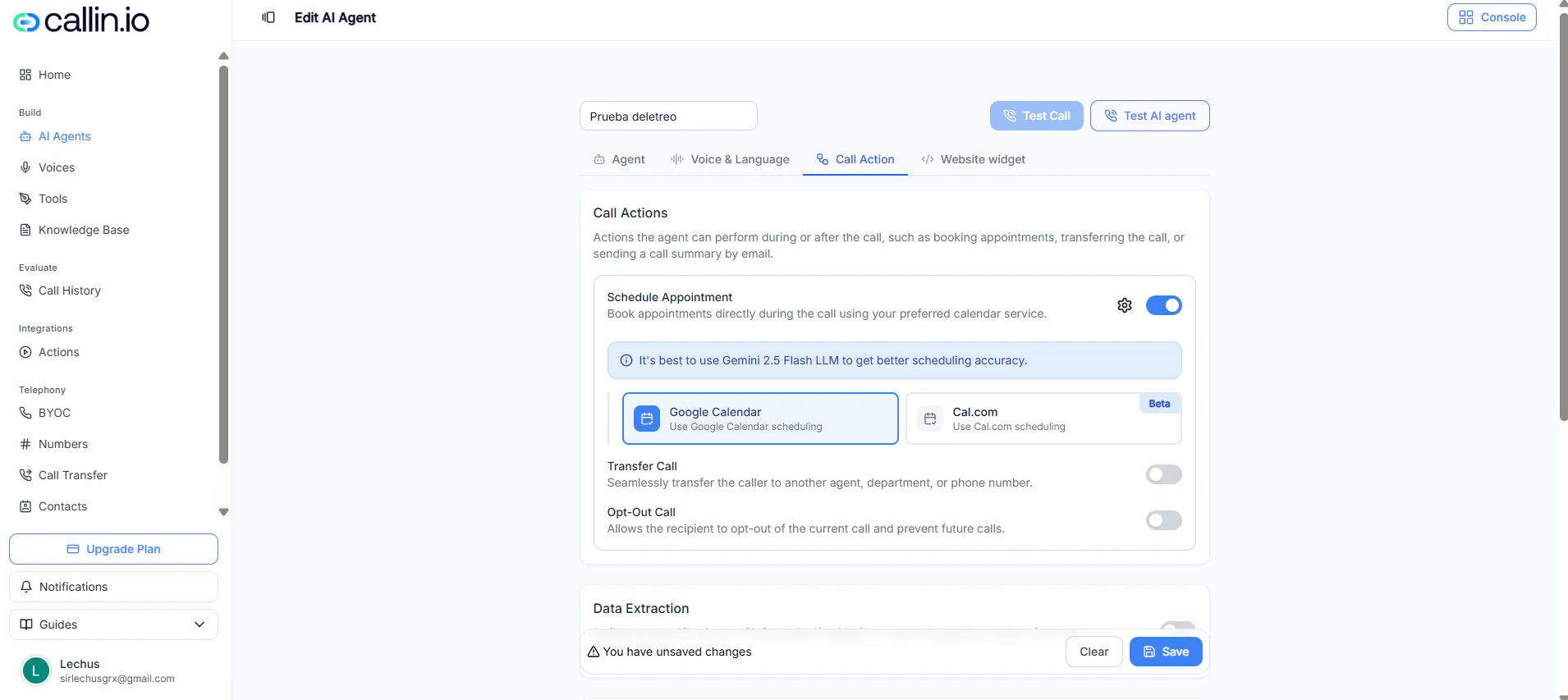
Screenshot: Inside the agent’s Call Action settings, enable scheduling and choose Google Calendar as the booking provider.
Important: For best results, ensure the agent’s timezone matches your calendar’s timezone. A mismatch can cause “wrong time” suggestions.
How booking should work during a call (recommended conversation flow)
Once everything is connected, the best experience is when the agent follows a simple, human flow:- Confirm intent
“Sure—do you want to book an appointment now?” - Collect the minimum required details
Ask for:- Full name
- Phone number
(Optionally: a short reason for the appointment, if relevant.)
- Offer availability and confirm
The agent should propose times it can book (based on your template + calendar availability), then confirm the chosen slot. - Book and confirm details
The agent books the event and repeats:- Date
- Time
- Duration
- What the appointment is for
Example (what “good” sounds like)
- Caller: “Can I book a time for a consultation?”
- Agent: “Yes. What’s your full name and the best phone number for the appointment?”
- Caller: “Jordan Lee, +1 555-010-2040.”
- Agent: “Thanks. Do you prefer earlier in the day or later? I can book a 30-minute consultation.”
- Caller: “Later is better.”
- Agent: “Great—does Thursday at 4:00 PM work?”
- Caller: “Yes.”
- Agent: “Perfect. You’re booked for Thursday at 4:00 PM for 30 minutes. You’ll also receive a reminder before the appointment.”
Tip: Keep the prompt focused on collecting details and confirming. Let the template handle the scheduling rules.
Prompt rules: what to include (and what to avoid)
What you should include in the prompt
Your prompt should instruct the agent to:- Ask for name and phone number before booking
- Confirm the appointment purpose briefly (one sentence)
- Confirm the selected time clearly before finalizing
- Confirm booking details at the end
- “When the caller wants to book, ask for their full name and phone number first. Then suggest available times and confirm the chosen time. After booking, repeat the date, time, and duration to confirm.”
What you should NOT include in the prompt
Avoid instructions that duplicate or override the Event Template, such as:- “Only book Monday to Friday”
- “Only book between 9am and 5pm”
- “Never book same-day appointments”
- “Only allow 1 appointment per day”
Important: Think of it this way:
Template = rules and availability
Prompt = conversation and data collection
Best LLM for scheduling: Gemini 2.5 Flash (recommended)
For scheduling accuracy, Callin.io works best with Gemini 2.5 Flash.Tip: If scheduling fails (wrong times, missed availability, confusion), switch the agent’s LLM to Gemini 2.5 Flash, save, and test again.
Troubleshooting checklist (quick fixes)
“I connected Google Calendar but I don’t see my calendar”
- Click Sync on the Google Calendar page.
- Confirm you connected the correct Google account.
“It says no availability”
- Check Working Hours in your Event Template (at least one day must be enabled).
- Confirm your Google Calendar isn’t fully blocked with busy events.
“The agent books at the wrong time”
- Verify the agent timezone matches the calendar timezone.
- If the behavior is inconsistent, switch to Gemini 2.5 Flash.
“Double bookings happen”
- Set Allow Event Overlap to No.
- Use a conflict option that blocks overlapping events.